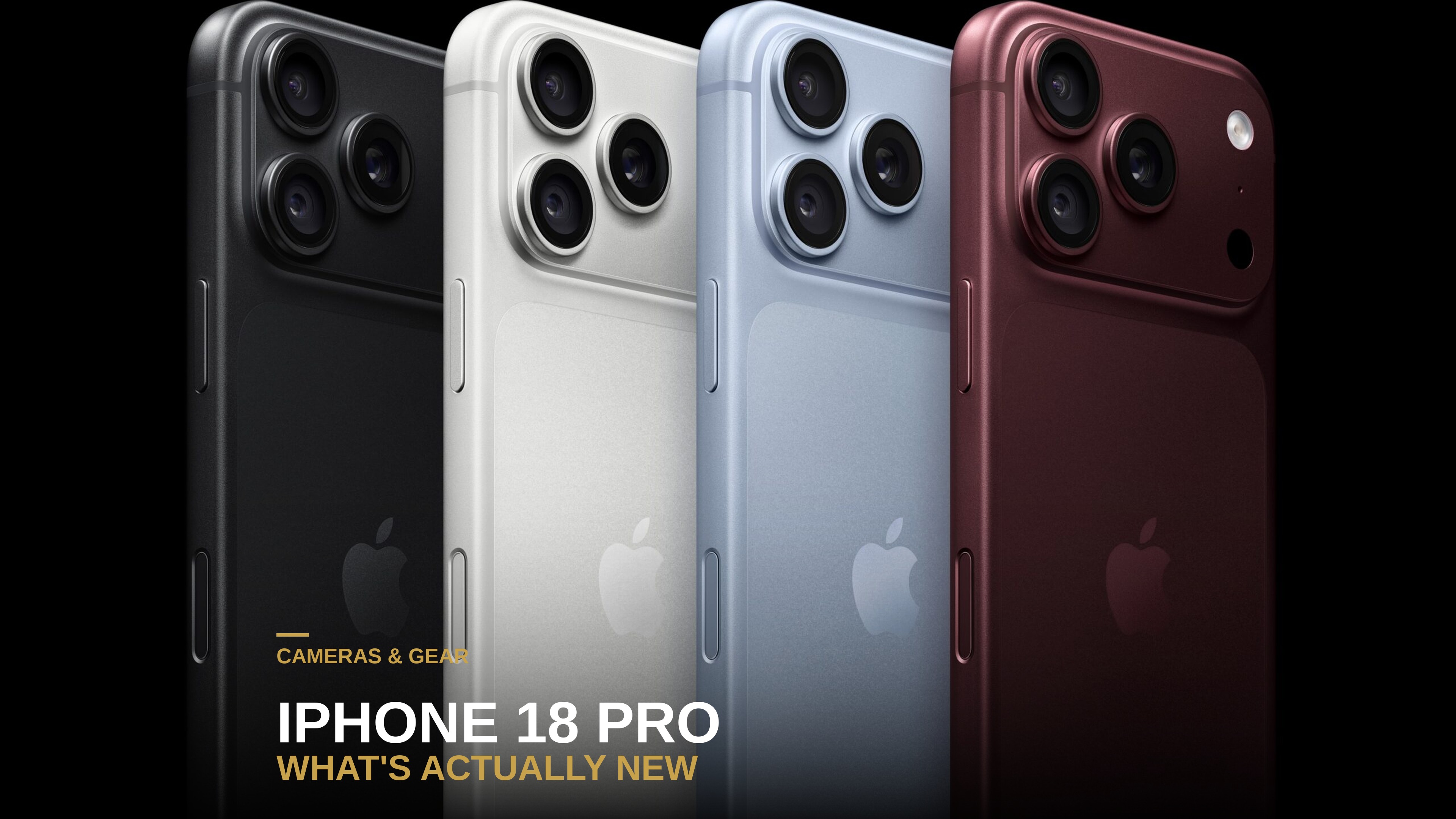
Every September I watch the same keynote, roll my eyes at the same marketing language, and then quietly work out whether this is finally the year my phone earns a permanent spot in the kit bag rather than just my pocket. Five years on from the iPhone 13 Pro — the phone that got me through the British Museum shoot — this might be that year.
I watched this one live, and I'll be honest: it felt thin. Battery, camera and chip carried almost the entire keynote, and a longer, more detailed run-through of those three would have suited me fine — instead a good chunk of the stage time went to Apple's new product category, the foldable iPhone Duo, which I've covered briefly near the end of this post but which isn't really what I'm after. I haven't bought anything yet. This is the research pass before I do: what's actually new on the iPhone 18 Pro and Pro Max, what's carried over from last year relabelled as new, what it means for both filming and stills, and where the Duo fits for anyone tempted by it instead.
The Chip: A20 Pro
Both the 18 Pro and 18 Pro Max share the same A20 Pro chip, built on a denser 2‑nanometer process with a 6‑core CPU, a 7‑core GPU with hardware-accelerated ray tracing, and a dual 16‑core Neural Engine. On paper that's the usual annual bump. In practice, chip efficiency is what everything else in this post depends on — better thermal headroom is what lets a phone sustain 4K ProRes RAW recording for more than a few minutes without throttling, which is the part that actually matters once you're filming rather than reading a spec sheet.
The Vapor Chamber, Explained
A vapor chamber is a sealed, flat metal chamber with a small amount of liquid inside. At the hot spot — directly under the chip — that liquid evaporates, spreads across the chamber as vapour, and condenses back to liquid at the cooler edges, carrying heat away far faster than a solid slab of metal ever could. It's the same basic principle used to cool gaming laptops and high-end cinema cameras, including bodies like the Nikon ZR, just built at phone scale.
Apple says the vapor chamber in the 18 Pro and Pro Max has three times the surface area of the one in the 17 Pro, for a 40% boost in sustained performance. As someone who's watched a camera quietly downclock itself twenty minutes into a long multicam record, that's not a marketing footnote — it's the difference between a phone that can actually hold 4K60 ProRes for the length of a real take and one that starts compressing quality to stay cool.
Battery: The Real Standout
Apple doesn't publish battery capacity in mAh on its own spec sheet — only hours of use — so the mAh figures below come from Chinese and US regulatory filings rather than Apple directly, and should be read as a close approximation rather than an official number. Apple's own figures, which are official, are video-playback hours, and they show the clearest generational jump in this entire release:
For anyone who wants the raw numbers: the 18 Pro Max is reported at roughly 5,391 mAh (international) / 5,567 mAh (US, eSIM-only), up from around 4,823 mAh / 5,088 mAh on the 17 Pro Max — nearly 500 mAh more, helped by the eSIM-only US models freeing up the space a SIM tray used to occupy. The 18 Pro comes in at roughly 4,056 mAh / 4,288 mAh. None of these are Apple's own published figures, so treat them as a reasonable estimate rather than a spec.
Photography: What's Actually New
This is the section I care about separately from filming, since I'll be shooting stills on this as well as video. The headline change is the same one that affects video — a genuine mechanical variable aperture on the 48MP Fusion Main camera, moving between ƒ/1.48 and ƒ/4.0 on six laser-cut blades rather than a fixed opening. For stills that means real in-camera control over depth of field and light without leaning entirely on computational tricks — closer to how a proper lens behaves.
- 48MP macro photography, using the Ultra Wide's closer focusing distance rather than a dedicated macro lens.
- Photographic Styles 3, with more precise control over tone and colour applied at the point of capture rather than as a filter afterward.
- Next-generation portraits with Focus and Depth Control — adjusting focus point and background blur after the shot, not just before it.
- Panorama up to 63MP and Night mode carried through and refined.
- Sapphire crystal lens cover on the Main camera, tougher than the standard glass used elsewhere on the phone.
- ProRAW for full manual control in post, same as recent Pro models.
- Camera Control, the physical control on the side of the phone, now covering exposure, depth, zoom, camera selection, styles and tone — one control surface instead of hunting through on-screen menus.
Filming Features That Actually Matter for My Work
ProRes RAW, Apple Log 2 and ACES support carried over from the 17 Pro, and they're still the backbone of why this is worth treating as a real camera rather than a backup one. RAW and Log give me the same grading latitude I lean on with the Nikon ZR's R3D NE files, just from something that lives in a pocket. Genlock — run through the Blackmagic Camera ProDock — is the one that actually changes what I'd use it for: frame-synced multicam without the usual post-production alignment work, which matters directly for the multicam events I run.
What's genuinely new to this generation, on top of that carried-over stack: Cinematic mode now runs up to 4K60 rather than 4K30, and its depth effects can be applied after the fact to ordinary video shot at up to 60fps rather than only to footage recorded in Cinematic mode at the time. There's a new 4K Dolby Vision time-lapse option, digital zoom during video extends to 24x, Smart Focus Tracking holds a moving subject more reliably, and low-light video benefits directly from the wider variable aperture rather than software processing alone.
Paired with the new manual Pro controls — aperture, shutter speed, white balance and a live histogram, all adjustable by hand — the variable aperture gives real exposure control in daylight without stacking an ND filter onto a phone, which is genuinely useful for quick B-roll and behind-the-scenes footage where I'm not going to rig anything up:
How It Stacks Up — 16 Pro to 18 Pro Max
Strip away the marketing and the generational jump looks like this, with the standard Pro and the Pro Max sitting side by side for each generation rather than only comparing Max to Max:
| Feature | 16 Pro | 16 Pro Max | 17 Pro | 17 Pro Max | 18 Pro | 18 Pro Max |
|---|---|---|---|---|---|---|
| Chip | A18 Pro | A18 Pro | A19 Pro | A19 Pro | A20 Pro | A20 Pro |
| Battery (video playback) | 27 hours | 33 hours | 33 hours | 39 hours | 36 hours | 45 hours |
| Battery capacity (est., mAh)* | ~3,582 | ~4,685 | ~4,252 | ~4,823 / 5,088 | ~4,056 / 4,288 | ~5,391 / 5,567 |
| Display | 6.3-inch | 6.9-inch | 6.3-inch | 6.9-inch | 6.3-inch | 6.9-inch |
| Main camera aperture | Fixed | Fixed | Fixed | Fixed | Variable, ƒ/1.48–ƒ/4.0 | Variable, ƒ/1.48–ƒ/4.0 |
| Optical-quality zoom range | 1x–5x | 1x–5x | 1x–8x | 1x–8x | 1x–8x | 1x–8x |
| Manual Pro controls | No | No | No | No | Yes | Yes |
| ProRes RAW | No | No | Yes | Yes | Yes | Yes |
| Apple Log | Log | Log | Log 2 | Log 2 | Log 2 | Log 2 |
| Genlock | No | No | Yes | Yes | Yes | Yes |
| Vapor chamber | No | No | Yes | Yes | Yes, larger | Yes, larger |
| UK price at launch (256GB) | £999 | £1,199 | £1,099 | £1,199 | £1,199 (+£100) | £1,299 (+£100) |
* Apple doesn't publish mAh figures. These are estimates from Chinese and US regulatory filings, not an official Apple spec — see the Battery section above.
That £100 jump on both the standard Pro and the Pro Max — the first UK price rise on either since the 15 Pro generation — isn't Apple padding its margin. The reporting lines up consistently: analyst firm TrendForce puts the cost of a 256GB memory chip up nearly 400% year-on-year, driven by AI data centre demand pulling manufacturing capacity away from consumer-grade RAM and flash storage toward enterprise server chips. Apple's own bill of materials for a 256GB Pro-model iPhone is reportedly up around 38% on that alone, on top of the usual cost of moving to a denser 2nm process for the A20 Pro chip. By most accounts Apple is still absorbing a chunk of that increase through lower margins rather than passing it all on — worth knowing if you were assuming the price rise was pure profit-taking.
Every Major Change Since My iPhone 13 Pro
For anyone reading this on an older iPhone trying to work out whether five-odd years of upgrades actually add up to something: here's the whole arc, generation by generation, not just the camera.
- iPhone 14 Pro (2022) — the Dynamic Island arrives. A16 Bionic chip, the notch replaced by the Dynamic Island, the first 48MP main sensor on iPhone, an Always-On display, and Crash Detection plus Emergency SOS via satellite.
- iPhone 15 Pro (2023) — the connector finally changes. A17 Pro on a 3nm process, USB-C replacing Lightning after more than a decade, a titanium frame replacing stainless steel, the mute switch replaced by the customisable Action Button, and a 5x tetraprism telephoto on the Pro Max.
- iPhone 16 Pro (2024) — a new control surface. A18 Pro, larger 6.3-inch and 6.9-inch displays across the whole Pro line, the new Camera Control button, a 48MP ultra-wide replacing the old 12MP one, and 4K120 Dolby Vision recording.
- iPhone 17 Pro (2025) — the professional video stack shows up. A19 Pro, an all-aluminium unibody with the first vapor chamber cooling in an iPhone, and in one generation: ProRes RAW, Apple Log 2, ACES colour support, Genlock and timecode via the Blackmagic Camera ProDock, Dual Capture from both cameras at once, and an 8x optical-quality zoom range.
- iPhone 18 Pro / Pro Max (2026) — battery, camera, chip. A20 Pro on a denser 2nm process, the first mechanical variable aperture on any iPhone, a vapor chamber with three times the surface area of the 17 Pro's, the biggest single-generation battery gain in iPhone history, and the next generation of Apple Intelligence and Siri.
None of that existed on the 13 Pro. No Log, no RAW, no Genlock, a fixed aperture, USB-C still years away, and a 3x telephoto that counted as impressive at the time. The 18 Pro Max isn't a small step from where I'm currently standing — it's a different category of camera wearing a familiar shape of phone.
Filming Accessories to Pair With It
The Other Announcement: iPhone Duo
The product that actually got the extra keynote time was the iPhone Duo — Apple's first foldable iPhone, opening like a book to a 7.6-inch inner display (about 50% larger than the 18 Pro Max's screen) behind a 5.4-inch cover screen, built on the same A20 Pro chip as the Pro line. It starts at £1,999 in the UK, roughly £700 more than the 18 Pro Max, with UK pre-orders from 16 October and availability from 23 October 2026.
Where it gives something up, for my purposes, is the camera: a dual 48MP system (Main and Ultra Wide) with no dedicated telephoto lens at all, against the Pro line's triple-camera 48MP system and its 8x optical-quality zoom range — the Duo tops out at 4x. Everything else — titanium frame, Ceramic Shield front and back, IP68 rating — is comparable to the Pro Max.
Who it's for: someone who wants a genuine mini-tablet and phone in one device — reading, documents, split-screen multitasking, maybe a hybrid work/personal device where the fold itself is the point. It's not obviously built for anyone whose priority is the camera system, which is where I sit. I'm still most interested in the 18 Pro Max.
Worth a Look Yourself
Apple's own pitch and the full technical specifications are on their site — worth reading directly rather than taking my summary as the last word: apple.com/iphone-18-pro and the full spec sheet.
Working with the 18 Pro Max already, or thinking about where it fits alongside a proper camera in a professional workflow? Get in touch: contact@niteshmistry.co.uk.